
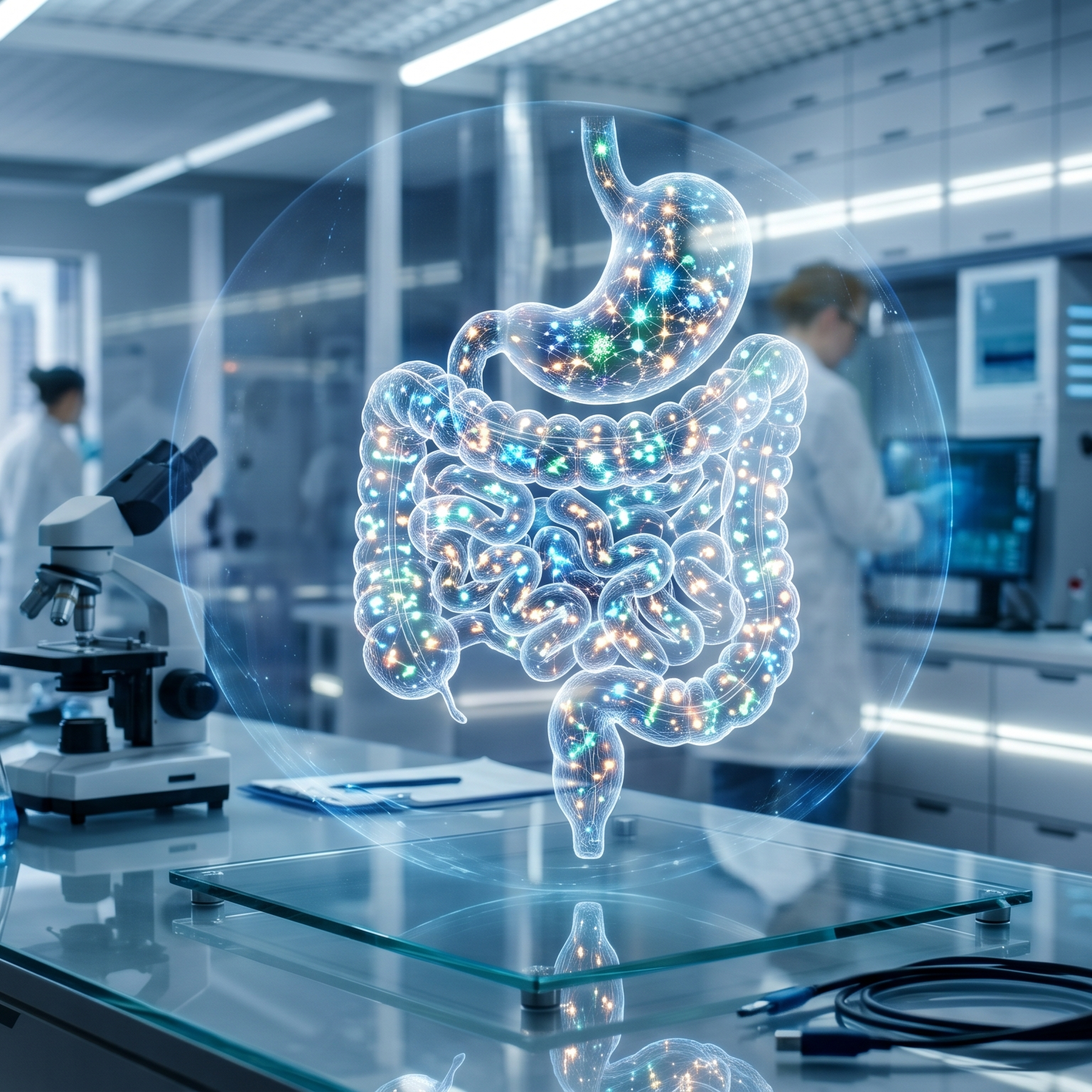
The gut has quietly become one of the most important frontiers in modern research. It isn’t just where food is digested — it houses roughly 70% of the immune system, produces neurotransmitters, and communicates constantly with the brain through what researchers call the gut-brain axis. At the center of it all sits a single layer of cells, the intestinal epithelium, held together by tight junctions that decide what gets absorbed and what stays out. When that barrier and the tissue around it are the research question, peptides keep coming up.
The reason is intuitive once you see it: many of the molecules the gut uses to repair, seal, and regulate itself are peptides — short amino-acid chains that act as signaling molecules. Several are even native to the digestive tract. Below are the peptides most often studied in gut-health research, what the science actually shows, and where each one really stands. This is an area where the evidence ranges from early preclinical work all the way to an FDA-approved drug — so the distinctions matter.
1. BPC-157: The Gut’s Native Repair Peptide
BPC-157 — short for “Body Protection Compound” — is a stable pentadecapeptide whose story begins in the stomach itself.
- The Mechanism: It is native and stable in human gastric juice and is studied as a mediator of gastrointestinal mucosal integrity, making it one of the most-referenced compounds in GI repair literature.
- The Evidence: Preclinical work has examined BPC-157 across the digestive tract — from ulcer and inflammatory-bowel-disease models to the gut-brain axis, where the same review notes effects extending to the liver, pancreas, and wound healing.
- The Caveat: The bulk of this evidence remains preclinical (largely rodent models), robust human clinical trials are limited, and BPC-157 is not approved for human use.
2. KPV: The Anti-Inflammatory Tripeptide
KPV (lysine-proline-valine) is a tiny three-amino-acid peptide — the C-terminal fragment of the hormone α-MSH — that punches well above its size in inflammation research.
- The Mechanism: Research shows KPV is transported into intestinal and immune cells via the PepT1 transporter, where it inhibits pro-inflammatory signaling — and PepT1 activity tends to rise in inflamed tissue, potentially concentrating the peptide where it’s most needed.
- The Evidence: Orally delivered KPV reduced the severity of chemically induced colitis in mouse models, and it appears in systematic reviews of anti-inflammatory peptides being explored for inflammatory bowel disease.
- The Caveat: The work is almost entirely preclinical — dedicated human clinical trials do not yet exist, and KPV is not an approved therapy.
3. Larazotide Acetate: The Barrier Regulator
Larazotide acetate (also called AT-1001) is an eight-amino-acid peptide built specifically around the “leaky gut” question — the science of intestinal permeability.
- The Mechanism: It acts as a zonulin antagonist and tight-junction regulator, helping restore intestinal barrier function by promoting the reassembly of the protein complexes that seal the gut lining.
- The Evidence: Larazotide advanced further than most gut peptides — through phase 2 trials in celiac disease as an adjunct to a gluten-free diet, and into a phase 3 program.
- The Caveat: Its pivotal phase 3 celiac trial was discontinued in 2022 after an interim analysis found the treatment effect too small to reach significance. It is not approved, and it’s a useful reminder that promising mechanisms don’t always survive large human trials.
4. Teduglutide: The Approved GLP-2 Benchmark
Teduglutide is the one that made it all the way — a peptide that proves gut-targeted signaling can become real, regulated medicine.
- The Mechanism: It’s a recombinant analogue of GLP-2 (glucagon-like peptide-2), a hormone that drives intestinal growth — increasing villus height, crypt depth, and absorptive surface area.
- The Evidence: In pivotal trials it reduced patients’ dependence on intravenous parenteral nutrition, which led the FDA to approve it (as Gattex) for short bowel syndrome in adults in 2012 and in children in 2019.
- The Caveat: Teduglutide is a prescription drug for a specific, serious condition — not a general “gut health” compound — and it carries real warnings (including a risk of intestinal polyps and obstruction) managed under medical supervision.
Quick Comparison: Gut-Health Peptides at a Glance
| Peptide | Primary Research Focus | Status |
|---|---|---|
| BPC-157 | Mucosal repair & gut-brain axis | Preclinical; not approved |
| KPV | Intestinal inflammation (NF-κB) | Preclinical; not approved |
| Larazotide | Tight junctions / permeability | Phase 3 discontinued; not approved |
| Teduglutide | Intestinal growth & absorption | FDA-approved (prescription) |
The Part Most Articles Skip: What “Gut Health” Claims Leave Out
Gut peptides are genuinely one of the more evidence-rich corners of peptide research — but the popular conversation runs well ahead of the data.
- “Leaky gut” is a real science with an overhyped name: Intestinal permeability and tight-junction dysfunction are legitimate, well-studied phenomena. “Leaky gut syndrome” as a stand-alone catch-all diagnosis, however, is not an established medical condition, and reputable research keeps the two separate.
- Preclinical is not clinical: BPC-157 and KPV rest largely on animal and cell-culture data. Larazotide shows how even a well-designed peptide can fall short in phase 3. Only teduglutide has crossed the approval line — and only for a narrow indication.
- “Research grade” is not medicine: Compounds sold as research chemicals are not approved pharmaceutical products and are not for human consumption. That framing exists for a reason.
Why Compound Purity Is a Research Variable, Not a Footnote
In gut research this is doubly true, because the readouts are so sensitive to contamination. Endotoxin (LPS) is itself a potent driver of intestinal inflammation — so a poorly purified peptide can introduce the very variable a colitis or barrier-function study is trying to measure, quietly corrupting the result. Truncated sequences and aggregation cause the same problem. If you can’t characterize what’s in the vial, you can’t trust the data that comes out of it. That’s why research integrity depends on third-party-tested material with a published Certificate of Analysis (COA) — identity confirmed by mass spectrometry, purity verified by HPLC.
Resource Links & References
Editor’s Note: For related reading, see our overview of BPC-157 and tissue healing and our 2026 peptide research overview.
- Sikiric et al. Brain-Gut Axis and Pentadecapeptide BPC 157: Theoretical and Practical Implications. Curr Neuropharmacol.
- Dalmasso et al. (2008). PepT1-Mediated Tripeptide KPV Uptake Reduces Intestinal Inflammation. Gastroenterology.
- Ghazvini et al. (2025). Anti-Inflammatory Peptides Against Inflammatory Bowel Diseases: A Systematic Review. JGH Open.
- Slifer et al. (2021). Larazotide Acetate: A Pharmacological Peptide Approach to Tight Junction Regulation. Am J Physiol Gastrointest Liver Physiol.
- Wilhelm & Lipari. GLP-2 Analogues as First Specific Treatment of Intestinal Failure (Teduglutide). PMC.
Disclaimer: All compounds discussed are intended for laboratory and research-and-development use only and are not approved for human consumption. Approved medications referenced are available only by prescription under medical supervision. This article is educational and does not constitute medical advice.