
Blog Post | SecurePeptideSolutions.com | Research & Education
Published: March 2026 | Category: Peptide Research, Industry Trends | Reading Time: ~10 min
Peptide Research in 2026: What Scientists and Researchers Are Watching Right Now
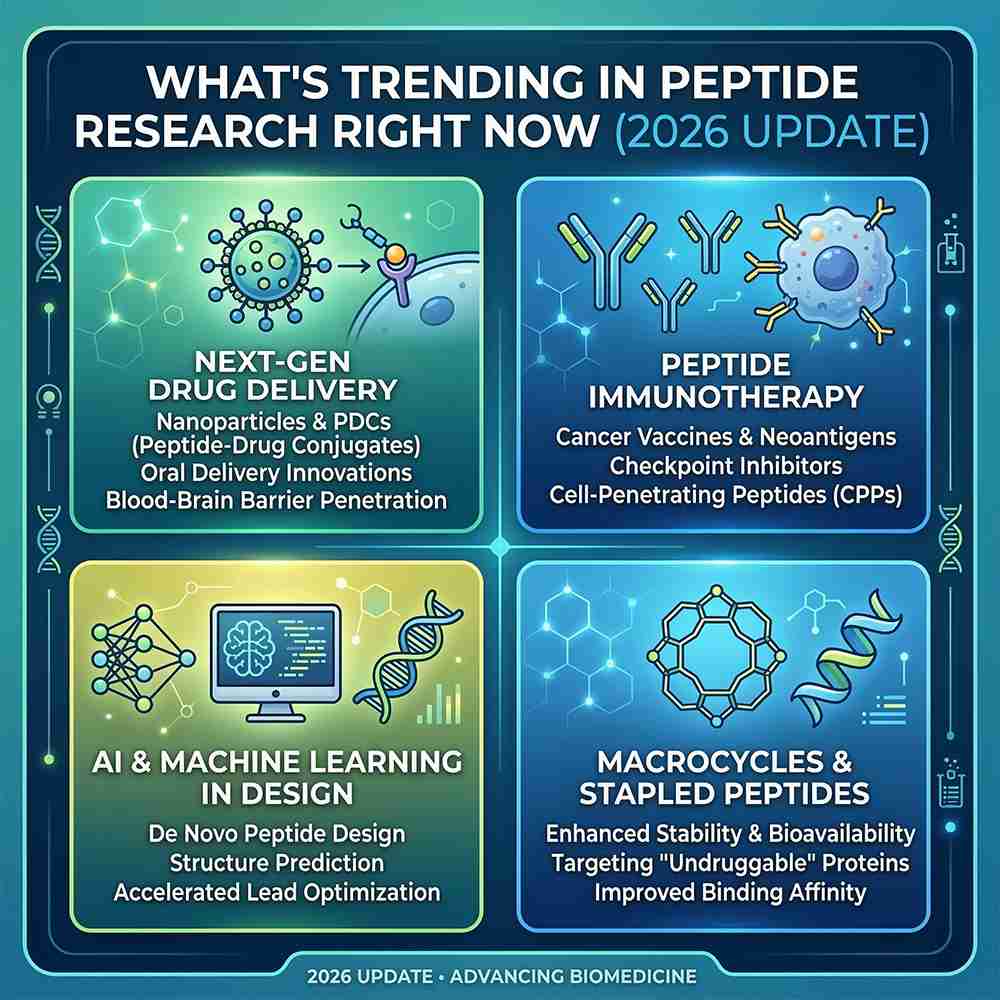
If you’ve been paying attention to the life sciences space lately, you already know that peptides are having a moment — and not a quiet one. From AI-driven molecular design to blockbuster metabolic therapies making headlines around the world, the peptide field has transformed from a niche corner of biochemistry into one of the most dynamic and fast-moving areas in all of modern research.
But beyond the mainstream buzz around GLP-1 drugs and weight-loss injections, there’s a deeper, more nuanced story unfolding in laboratories across the globe. Researchers are quietly rewriting the rules of what peptides can do — how they’re designed, manufactured, delivered, and applied across a staggering range of therapeutic areas.
At Secure Peptide Solutions, we stay close to the research. This post breaks down the major trends, discoveries, and scientific developments shaping the peptide landscape in 2026 — sourced from peer-reviewed literature, market analysis, and leading scientific publications — all in one place.
Disclaimer: All content on this blog is intended for educational and research purposes only. Secure Peptide Solutions provides research-grade peptides for laboratory use and does not offer medical advice. Consult a licensed healthcare professional before considering any peptide use.
1. The Peptide Market Is Booming — and the Numbers Back It Up
The numbers are hard to ignore. According to a February 2026 market analysis report, the global peptide synthesis market is valued at approximately $1.9 billion this year, with projections pointing to $2.59 billion by 2031 — growing at a CAGR of around 6.4%. The broader peptide therapeutics sector carries even more ambitious long-term projections, with analysts suggesting the market could surpass $1 trillion in total value by 2050.
What’s driving this growth? A few key factors stand out:
- Superior target specificity — peptides can be engineered to bind with extraordinary precision to specific receptors or proteins, reducing off-target effects that plague many small-molecule drugs.
- Lower systemic toxicity compared to conventional small molecules, making them attractive candidates for chronic disease management.
- Manufacturing advances — microwave-assisted solid-phase peptide synthesis (SPPS) has compressed production timelines from hours to minutes while pushing crude purity levels above 90%, dramatically improving cost efficiency.
- Regulatory momentum — the FDA approved four new peptide-based drugs in 2024 alone, and guidance frameworks for synthetic peptides have been streamlined to encourage first-in-class applications.
North America currently leads global revenue at roughly 40% of market share, with Asia-Pacific close behind and growing at a faster clip — driven by cost-competitive contract development and manufacturing organizations (CDMOs) in China and South Korea.
2. GLP-1 Peptides and Metabolic Medicine: Far More Than Weight Loss
By now, most people have heard of semaglutide and tirzepatide. What began as diabetes medications have become cultural phenomena, with millions of patients using GLP-1 receptor agonists for obesity management. But the story researchers are watching most closely isn’t about weight loss — it’s about what comes next.
The expanding clinical portfolio of these peptides is genuinely remarkable. Tirzepatide, a dual GIP/GLP-1 agonist already approved for obesity and type 2 diabetes, is now in active trials for:
- Heart failure with preserved ejection fraction (HFpEF) — the SUMMIT trial has yielded data that could establish tirzepatide as the first incretin therapy approved for heart failure, which would represent a major paradigm shift in cardiology.
- Metabolic-associated steatohepatitis (MASH) — researchers are leveraging the significant metabolic improvements that accompany major weight reduction to target liver disease.
- Obstructive sleep apnea — the SURMOUNT-OSA Phase 3 trial returned positive results, opening a new potential indication for GLP-1-class peptides.
- Chronic kidney disease — early-stage trials are exploring the renoprotective effects of tirzepatide, following a path similar to semaglutide’s FLOW trial.
Meanwhile, next-generation incretin therapies are pushing even further. Retatrutide — a triple GIP/GLP-1/glucagon agonist currently in Phase 3 — has reported the highest weight-loss outcomes of any investigational peptide to date, sitting at 28.7% body weight reduction in trial data. The emergence of these multi-agonist compounds reflects a broader trend in metabolic medicine: the shift from single-target to multi-pathway intervention.
Oral formulations are also arriving. Several pharmaceutical companies are advancing oral peptide delivery systems, with Merck committing $493 million to an oral-peptide licensing deal — signaling serious industry confidence that the injection requirement for this drug class is not permanent.
3. AI Is Redesigning Peptide Science from the Ground Up
If there’s one development that researchers across the industry are watching with something close to awe, it’s the role that artificial intelligence is now playing in peptide discovery and design. This isn’t incremental — it’s a fundamental reimagining of how new compounds are found.
In 2025, researchers began deploying deep learning models not just to predict peptide properties, but to actively engineer novel bioactive sequences with tunable aggregation and self-assembly characteristics. One particularly notable example is ProteoGPT, a generative AI system described in Nature Microbiology, which produced novel antimicrobial peptides capable of targeting specific bacterial strains with precision.
What makes this so significant from a research standpoint is the speed differential. Traditional wet-lab discovery pipelines — the iterative process of designing, synthesizing, testing, and modifying peptide candidates — could take years to produce a viable lead compound. AI-driven design compresses that timeline to hours in silico, with candidates ready for immediate experimental validation.
The practical implications for research include:
- Targeted design against specific bacterial strains, making AI-generated antimicrobial peptides (AMPs) a serious tool in the fight against antibiotic resistance.
- Accelerated screening for oncology applications — personalizing peptide-based approaches to cancer immunotherapy based on patient-specific tumor antigens.
- Nanomaterial integration — machine learning combined with nanoparticle engineering is opening new drug delivery pathways that were previously theoretical.
The 2026 clinical pipeline is expected to see several AI-designed peptides advancing into early-phase human trials, particularly for antimicrobial resistance and metabolic disorders. This is no longer a future-forward concept — it’s happening now.
4. Tissue Repair and Recovery Peptides: BPC-157, TB-500, and the Research Landscape
Outside of the metabolic space, one of the most active and arguably most contested areas of peptide research involves compounds associated with tissue repair and healing — specifically BPC-157 (Body Protection Compound-157) and TB-500 (a synthetic form of Thymosin Beta-4).
These peptides occupy what MIT Technology Review recently called an ‘unapproved bucket’ — compounds that are not FDA-approved for human therapeutic use, but are widely used in research settings and increasingly discussed in clinical, functional medicine, and longevity circles. The research interest is understandable. Preclinical studies have shown BPC-157 demonstrating effects on:
- Tendon-to-bone healing and soft tissue repair in animal models
- Gastrointestinal mucosal protection and regeneration
- Modulation of inflammatory pathways
- Angiogenesis — the formation of new blood vessels in healing tissue
TB-500 (Thymosin Beta-4) has similarly shown promise in preclinical work related to wound healing, cardiac tissue recovery, and neuroregeneration, with interest from researchers studying recovery after ischemic events.
It’s important to be clear about where the science stands: the overwhelming majority of BPC-157 and TB-500 research has been conducted in vitro or in animal models. Human clinical trials for these specific compounds remain limited. Regulatory oversight of research-grade peptides in this category is increasing in 2026, with the FDA paying closer attention to compounding practices and marketing claims.
For research purposes, the quality of your source material matters significantly. When working with peptides like BPC-157, TB-500, or any unapproved research compound, verified purity documentation — including HPLC chromatograms and mass spectrometry confirmation — is non-negotiable.
5. Antimicrobial Peptides (AMPs): A Promising Front in the Antibiotic Resistance Crisis
Antibiotic resistance is one of the most serious public health challenges of our time, and peptide researchers are increasingly focusing on antimicrobial peptides (AMPs) as a potential solution. AMPs are a class of naturally occurring and synthetic peptides that can disrupt bacterial cell membranes, often through mechanisms that are significantly harder for bacteria to develop resistance against compared to conventional antibiotics.
The science here is genuinely exciting. AMP research in 2025 and early 2026 has shown:
- Activity against multidrug-resistant organisms (MDROs) including MRSA and certain gram-negative pathogens
- Synergistic effects when used in combination with existing antibiotics, potentially ‘resensitizing’ resistant bacteria
- AI-assisted discovery pipelines generating novel AMP candidates in hours rather than years
- Exploration of delivery via nanoparticle and liposome systems to improve bioavailability and reduce off-target effects
The Nature publication framework around ACS Omega’s recent therapeutic peptide review highlights how sustained research investment — particularly in the U.S. and China — is producing an accelerating body of literature in this area. If clinical translation catches up with the preclinical promise, AMPs could represent a genuine breakthrough in infectious disease management over the next decade.
6. Personalized Peptide Protocols: The Move Toward Precision Therapeutics
One of the more striking clinical trends of 2026 is the growing movement toward personalized peptide therapy — the idea that peptide protocols should be tailored to an individual’s specific biomarker profile, genetic data, and health goals rather than applied as blanket interventions.
This is being driven by several converging factors: wider access to functional lab testing, better understanding of peptide receptor pharmacokinetics, and a growing base of clinical experience from integrative and functional medicine practitioners. The tools now exist to layer peptide protocols on top of detailed patient data in ways that simply weren’t possible five years ago.
For the research community, this trend underscores something important: peptides are not monolithic. Their effects are highly context-dependent — influenced by dosing timing, co-administration with other compounds, individual receptor sensitivity, hormonal milieu, and delivery method. This complexity is exactly why rigorous research, standardized protocols, and high-purity source materials are essential for generating reliable, reproducible data.
7. What Researchers Should Know About Peptide Purity and Quality in 2026
With more suppliers entering the market than ever before, the question of peptide quality has become more — not less — critical. A growing catalog doesn’t automatically mean growing quality, and the documentation standards that separate serious research-grade suppliers from the rest are specific and verifiable.
The two analytical methods that form the backbone of peptide verification are:
HPLC (High-Performance Liquid Chromatography)
HPLC profiles compound purity by separating the target peptide from impurities and expressing the result as a percentage of chromatographic peak area. A purity result above 99% from HPLC is the accepted standard for research-grade compounds. A purity percentage without the underlying chromatogram is not sufficient documentation for serious research purposes.
Mass Spectrometry (MS)
While HPLC confirms purity, MS confirms identity — it verifies that the compound you received matches the molecular weight of the intended sequence. These are two distinct questions. HPLC purity alone cannot confirm you have the right peptide. Both methods should appear on every Certificate of Analysis (COA).
When evaluating a supplier, look for documentation that includes the full HPLC chromatogram (not just a summary percentage), MS confirmation of molecular identity, lot-specific COAs that match your specific order, and transparent synthesis and testing methodology.
At Secure Peptide Solutions, every compound ships with a full COA including HPLC chromatogram and mass spectrometry data. Research integrity starts with source integrity.
The Bottom Line: Peptide Research Has Never Been More Active
Whether you’re investigating metabolic pathways, exploring tissue regeneration mechanisms, working in oncology, or studying antimicrobial resistance, peptides sit at the intersection of nearly every major frontier in modern biomedical research.
The science is moving fast. AI is compressing discovery timelines. Manufacturing is scaling. And the regulatory landscape is evolving in ways that reward documentation, transparency, and quality — the same values that serious researchers have always demanded from their suppliers.
Staying current with the literature isn’t just academic — it directly informs how you design experiments, interpret results, and source compounds. We’ll continue updating this blog with the research developments that matter most to our community.
Have questions about specific compounds, COA documentation, or research use cases? Reach out to the Secure Peptide Solutions team — we’re here to support your work.
References & Further Reading
1. Peptide Synthesis Market Report 2026-2031, ResearchAndMarkets.com / GlobeNewswire, February 2026
2. Ten Peptide Breakthroughs of 2025 Define Global Medical Trends for 2026. Intelligent Living, January 2026
3. Peptides in Clinical Trials 2026: What Is Coming Next. Peptide Protocol Wiki, February 2026
4. Peptides Are Everywhere — Here’s What You Need to Know. MIT Technology Review, February 2026
5. Advance in Peptide-Based Drug Development: Delivery Platforms, Therapeutics and Vaccines. Nature / Signal Transduction and Targeted Therapy, 2025
6. Recent Advances in Therapeutic Peptides: Innovations and Applications. ACS Omega, 2025
7. 2026 Peptide Industry Report: Top Verified Research Peptide Vendors. BioLongevity Labs, March 2026
8. Peptide Therapy Trends 2026: What Clinics Must Know. Optimantra, 2026
9. Peptide Drug Summit 2026, peptide-drug-summit.com
SEO Keywords: peptide research 2026, BPC-157 research, TB-500 peptide, GLP-1 peptides, antimicrobial peptides, research grade peptides, peptide purity HPLC, AI peptide design, peptide therapeutics, research peptide supplier