
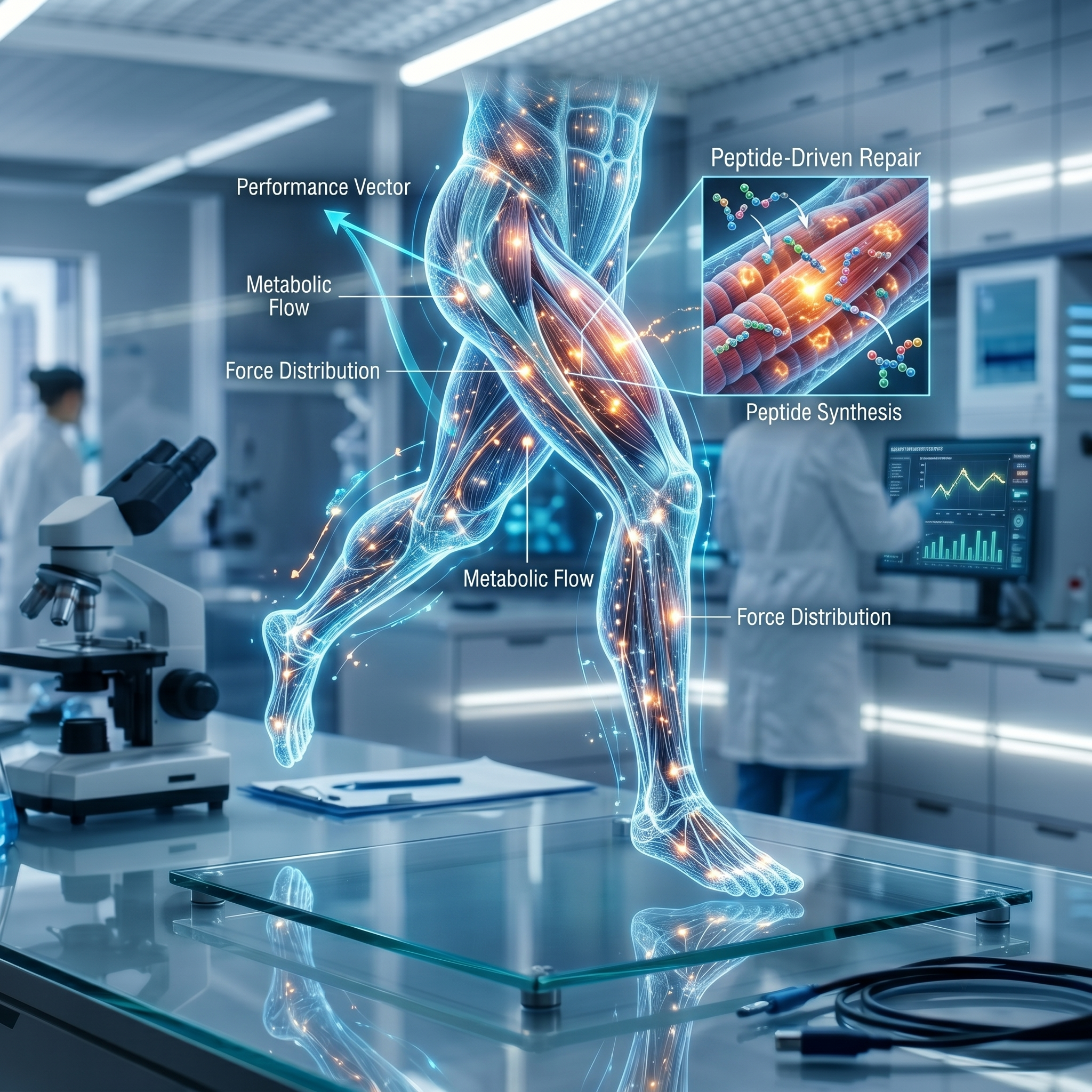
In sports medicine, the central question never really changes: how does tissue recover from load, and can that recovery be understood — and studied — more precisely? Athletes, clinicians, and researchers have always chased the same goal, faster and cleaner repair of muscle, tendon, ligament, and bone. Over the last few years, one class of compounds has dominated that conversation more than any other: research peptides.
Unlike broad pharmaceuticals that blanket the whole system, peptides are short chains of amino acids that act as signaling molecules. They speak the body’s own language, carrying instructions between cells that govern angiogenesis (new blood-vessel formation), collagen synthesis, and cellular repair. That specificity is exactly why they’ve become such a rich subject for laboratory study in the recovery space. Here’s an honest look at the compounds the research actually focuses on — with the science linked to its sources.
1. BPC-157: The Tissue-Repair Research Staple
Derived from a sequence identified in gastric protein, BPC-157 is the single most-referenced peptide in preclinical tissue-repair literature.
- The Research Interest: Animal-model studies have explored its relationship to angiogenesis and connective-tissue healing, including muscle and tendon injury models where it appeared to modulate VEGF expression.
- The Mechanism: Mechanistic reviews describe activation of VEGFR2 and nitric-oxide pathways via the Akt–eNOS axis, which govern the blood supply a healing tissue depends on.
- The Caveat: A 2025 systematic review in orthopaedic sports medicine identified 36 relevant studies — 35 preclinical and only one clinical — underscoring that human evidence is extremely limited and that BPC-157 is not approved for human use.
2. TB-500 (Thymosin Beta-4): The Cell-Migration Candidate
If BPC-157 is the most-studied, TB-500 — a synthetic fragment related to the actin-binding protein Thymosin Beta-4 — is its most common research companion.
- The Finding: The parent molecule is produced naturally in response to injury and has been investigated for its role in cell migration, angiogenesis, and the wound-healing environment.
- The Mechanism: By sequestering G-actin and regulating the actin cytoskeleton, it is studied for how cells move toward and rebuild a site of damage — a foundational step in soft-tissue recovery.
- The Caveat: Like BPC-157, the human clinical evidence base for sports-injury applications is thin, it is not FDA-approved, and long-term safety data is lacking. The two follow nearly identical regulatory paths.
3. GHK-Cu: The Copper Connection
GHK-Cu (Copper Tripeptide-1) is a copper-binding tripeptide best known in skin and connective-tissue research.
- The Research Interest: It appears extensively in regenerative literature, where gene-expression studies report increased collagen, elastin, and glycosaminoglycan synthesis and support for dermal fibroblasts.
- The Mechanism: The same body of work examines how GHK-Cu modulates matrix-remodeling pathways and the tissue-repair response to injury.
- The Caveat: Its role in athletic or musculoskeletal repair specifically is far less characterized than its dermatological research, and remains an open question rather than a settled finding.
4. Growth-Hormone Secretagogues: The Recovery Axis
Compounds such as CJC-1295, Ipamorelin, and Sermorelin are studied not for direct tissue action but for their effect on the body’s own growth-hormone signaling.
- The Target: They act on growth-hormone-releasing pathways, and researchers study how the resulting GH/IGF-1 axis connects to tissue turnover and recovery. Ipamorelin was characterized as a selective GH secretagogue that raises GH without significantly affecting cortisol or other pituitary hormones.
- The Mechanism: Rather than introducing a hormone directly, they are investigated for prompting the pituitary’s natural pulsatile release — a more physiologic research model than exogenous hormone.
- The Caveat: These are classified as peptide hormones and growth factors, a category that carries the heaviest regulatory and anti-doping consequences of anything on this list (see below).
Quick Comparison: Research Focus at a Glance
| Peptide | Primary Research Focus | Studied In The Context Of… |
|---|---|---|
| BPC-157 | Angiogenesis & tissue repair | Tendon/ligament injury models |
| TB-500 | Cell migration | Soft-tissue wound environments |
| GHK-Cu | Collagen & matrix signaling | Connective tissue & skin |
| CJC-1295 / Ipamorelin | GH/IGF-1 axis | Recovery & tissue turnover |
The Part Most Articles Skip: Regulatory & Anti-Doping Status
This is the section that separates serious research framing from marketing hype.
- FDA status: None of these compounds is approved for human therapeutic use. They exist in the market strictly as laboratory research chemicals, and regulators have specifically scrutinized several of them.
- Anti-doping status: For any work connected to athletes, this is decisive — BPC-157 is prohibited at all times under the World Anti-Doping Agency framework, and TB-500 and the growth-hormone secretagogues fall under the same prohibited categories. Always check the current WADA Prohibited List.
- The label loophole that isn’t: A “research use only” or “not for human consumption” label does not exempt a substance from prohibition. WADA prohibits unapproved substances regardless of how they are marketed, there is generally no Therapeutic Use Exemption available, and athletes have already received multi-year sanctions for these exact peptides.
Why Compound Purity Is a Research Variable, Not a Footnote
In a market flooded with “research chemicals,” purity isn’t a luxury — it’s a methodological requirement. Unverified material can contain truncated or mis-sequenced chains, endotoxins, or microbial contaminants, any of which can quietly invalidate a study before it begins. If you can’t characterize what’s in the vial, you can’t trust what comes out of the experiment. That’s the reasoning behind insisting on third-party-tested material with a published Certificate of Analysis (COA) — identity confirmed by mass spectrometry, purity verified by HPLC. For research integrity, that documentation is the whole ballgame.
Resource Links & References
Editor’s Note: For foundational context, see our 2026 peptide research overview and our deep dive on BPC-157 and tissue healing.
- Vasireddi et al. (2025). Emerging Use of BPC-157 in Orthopaedic Sports Medicine: A Systematic Review. HSS Journal / PMC.
- BPC-157 Mechanisms: VEGFR2 and Nitric-Oxide Signaling in Tissue Regeneration (PMC review).
- Brcic et al. (2009). Modulatory effect of BPC 157 on angiogenesis in muscle and tendon healing. J Physiol Pharmacol.
- Thymosin Beta-4 in Regenerative Therapies: Actin Regulation & Cell Migration (PMC review).
- Pickart & Margolina (2018). Regenerative and Protective Actions of the GHK-Cu Peptide in the Light of New Gene Data. Int J Mol Sci.
- Raun et al. (1998). Ipamorelin, the first selective growth hormone secretagogue. Eur J Endocrinol.
- USADA — BPC-157 Prohibited Status · WADA Prohibited List.
Disclaimer: All compounds discussed are intended for laboratory and research-and-development use only and are not approved for human consumption. This article is educational and does not constitute medical advice. Always consult a qualified professional regarding regulatory and anti-doping obligations.