
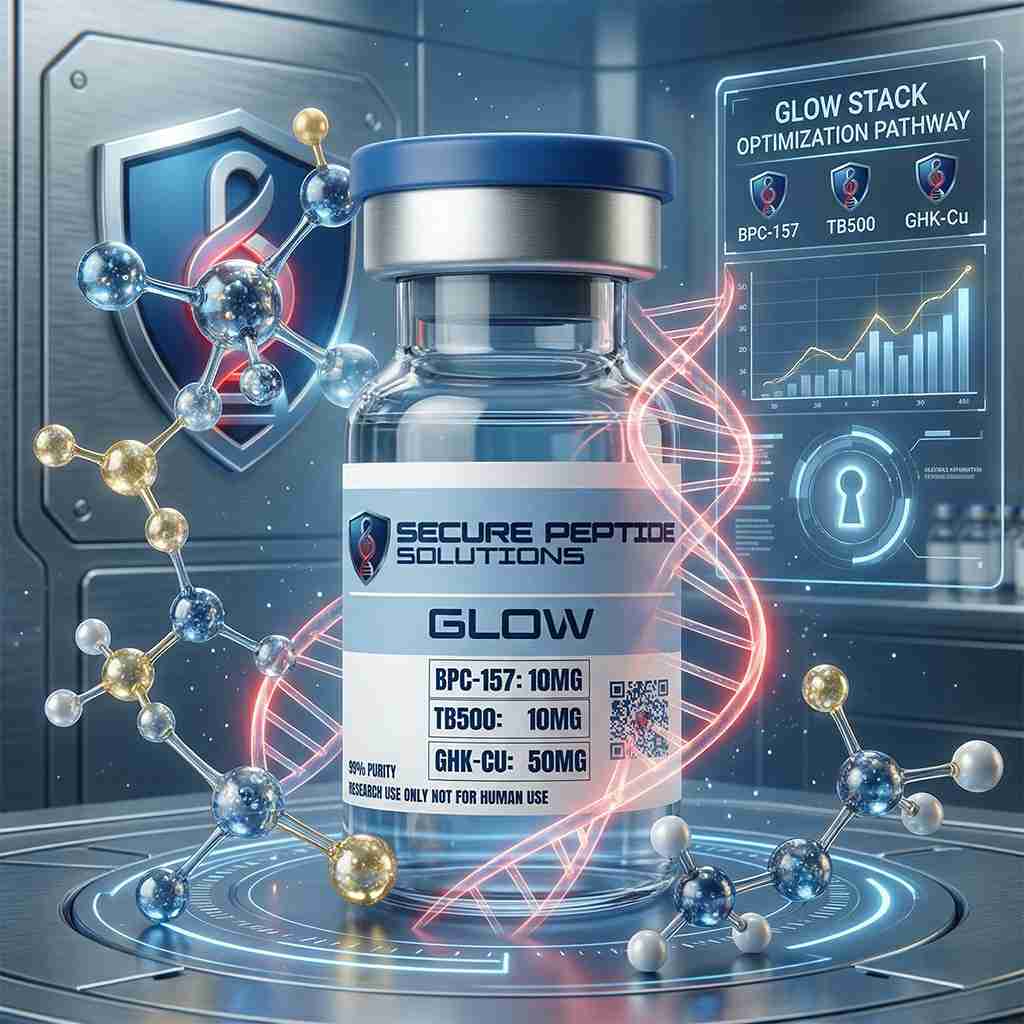
The GLOW Protocol: Investigating the Mechanisms of Cellular Repair
In the field of biochemical research, the “GLOW” protocol has emerged as a primary focus for studying tissue regeneration and localized cellular signaling. This specific combination—comprising GHK-Cu, BPC-157, and TB-500—is being widely analyzed for its synergistic potential in laboratory models.
At Secure Peptide Solutions, we provide high-purity compounds strictly for laboratory research. Below is an overview of the current scientific literature regarding the mechanisms of action for these three research agents.
1. GHK-Cu (Glycyl-L-histidyl-L-lysine copper)
GHK-Cu is a naturally occurring copper complex first identified in human plasma. In a research setting, it is primarily studied for its role as a gene modulator.
- Extracellular Matrix (ECM) Synthesis: Research indicates that GHK-Cu stimulates fibroblasts, the cells responsible for the production of collagen and elastin. Data suggests this leads to an increase in structural protein density in skin tissue models.
- Genomic Regulation: Preliminary studies have suggested that GHK-Cu may influence the expression of thousands of genes, shifting them toward a state associated with younger, more efficient cellular repair cycles.
- Follicular Research: In vivo studies have observed that GHK-Cu may increase the size of hair follicles and promote localized angiogenesis (the formation of new blood vessels).
2. BPC-157 (Body Protection Compound)
BPC-157 is a pentadecapeptide consisting of 15 amino acids. While widely known for its stability in gastric juice, its research applications extend to dermal and connective tissue repair.
- Angiogenic Properties: Research demonstrates that BPC-157 upregulates the expression of vascular endothelial growth factor (VEGF). This process is critical for studying how tissues recover from oxygen deprivation and physical trauma.
- Dermal Modeling: In laboratory trials, BPC-157 has been observed to accelerate the migration of cells to the site of an injury, providing a faster “closing” of the wound gap in tissue cultures.
3. TB-500 (Thymosin Beta-4)
TB-500 is a synthetic version of the naturally occurring peptide Thymosin Beta-4. Its primary mechanism of interest in a research environment is G-actin sequestration.
- Cellular Migration: TB-500 plays a pivotal role in the movement of cells. By regulating actin, it allows repair cells to travel more efficiently to damaged areas within a research model.
- Inflammatory Pathway Analysis: Studies suggest TB-500 may downregulate pro-inflammatory cytokines, making it a valuable subject for research into chronic inflammatory states and tissue flexibility.
Observed Synergy in Research Models
When these three compounds are studied in tandem, researchers often observe a “compounding effect” that exceeds the results of the peptides in isolation.
| Mechanism of Interest | GHK-Cu | BPC-157 | TB-500 |
| Primary Focus | Genetic Expression | Vascularization | Cellular Mobility |
| Tissue Impact | Structural Integrity | Nutrient Delivery | Inflammation Control |
| Research Value | Anti-Aging Models | Wound Healing Models | Recovery Models |
Conclusion: Foundations for Further Study
The GLOW protocol represents a significant frontier in peptide science. By addressing the genetic, vascular, and mobile aspects of cellular repair, researchers can gain a more comprehensive understanding of how multi-peptide stacks influence biological systems.
Disclaimer: The peptides mentioned, including GHK-Cu, BPC-157, and TB-500, are intended for laboratory research purposes only. They are not intended for human consumption, nor are they intended to treat, cure, or prevent any disease. All research should be conducted by qualified professionals in a controlled environment.